Antiphoner
Mass for a confessor that is also a pope
F-lxyd

General Information
Northern Textualis
Original Condition
A large-format choir book on good quality parchment.
Current Condition
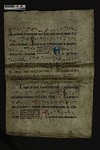
Although it is now a loose wrapper, the leaf was at some point re-used to make covers for a laced-case binding. The physical appearance of the fragment gives this away: The edges are folded over, and in the middle of the page the folds and curvature of the parchment emulate the shape of the original host volume's spine. Two sets of six double holes for laced-in endbands are visible in the spine folds, as well as two holes on each fore-edge for bands to tie the boards together. A spine title in a seventeenth century hand reads ANTIBELLARM. D. Samuelis Huberi, accompanied by remnants of labels.
Book Decoration and Musical Notation
The fragment is decorated in the fashion typical for late medieval choir books from Northern Europe. It is rubricated, and the beginnings of chants are marked either with red or blue initials, or black and red cadels.
Square notation on red four-line staffs.
Content
-
Content Item
- Text Language Latin
- Title Psalms, antiphons and verses for a confessor that is also a pope
-
History
The general appearance of the fragment suggests a Northern European of the antiphoner, likely Danish or Northern German origin.
Steffen Hope points out that the fragment likely comes from a church rather than a monastery, containing the features of secular usus.
The host volumes belonged to Herlufsholm Skole, a private Latin school located in Næstved, Sealand founded in 1565 on the grounds of a secularised Benedictine monastery, St Peders Kloster. The old library of Herlufsholm was transferred to the University Library of Southern Denmark in 1968-69.
The fragment's primary provenance is unclear. It is currently used as a loose wrapper for three early seventeenth century music books kept under the shelfmark RARA Musik M4. These music books are bound in leaves from a different liturgical manuscript, a breviary. However, as noted under Current Condition, the original host volume was a different one. From the faint spine title it can be deduced that the original host volume must have been Herlufsholm 29.4. The back board of the now coverless book contains the offset of the blue D initial on the side of the fragment originally facing the boards. Herlufsholm 29.4 entered the Herlufsholm collection in the late eighteenth century as part of the donation of Otto Thott, bearing the commemorative ex libris on the inside of its front cover. An earlier provenance inscription at the bottom of the title page identifies a previous owner as Petrus Danckwerth (1580-1652), vicar of Husum. The binding dates from this period, perhaps it was commissioned by Danckwerth himself. This implies that the manuscript from which the fragment was taken originated from a church or monastic house in Husum or the surrounding area, at the time under Danish control. There is also an oval stamp on the title page, but it is blurry and remains unidentified.
Host Volume
The back board of Herlufsholm 29.4 preserves an offset of the blue D initial on the verso side of the fragment. The binding has six raised bands, woven cloth spine supports, and part of the otherwise naked book block is covered by a thin layer of blank parchment or paper. It was restored by bookbinder Axel Pedersen according to a stamp on the inside of the back cover (A. P. Kons. 1975).
Bibliography
-
Holck, Jakob Povl. Den Gamle Verdens Magi: Bogsamlingen Fra Herlufsholm På Syddansk Universitetsbibliotek. Syddansk Universitetsbibliotek, 2015.
portal.findresearcher.sdu.dk/da/publications/den-gamle-verdens-magi-bogsamlingen-fra-herlufsholm-på-syddansk-u/ -
Hope, Steffen: Samlet oversigt over rapporter, tabeller og metadata samlet i perioden
01.11.17-28.02.18 (internal report for the University of Southern Denmark). -
Hope, Steffen. Liturgical Fragments at the Library of the University of Southern Denmark, blog post on sdu.dk.
https://www.sdu.dk/en/forskning/cml/news/blog_steffen2018_1