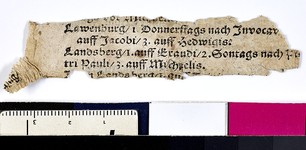
German printed calendar
F-hnre

General Information
Gothic type
The edition of the calendar has not been identified yet, but it bears some similarities to calendars by David Herlitz printed in Szczecin at the beginning of the 17th century. The towns listed on the fragments are located in Pomerania (now divided between Germany and Poland).
Original Condition
Current Condition
Content
-
Content Item
- Text Language German
- Title Register of market dates
-
Content Description
The dates are given relative to the liturgical year, but listed alphabetically according to the place names.
-
History
Pomerania, possibly Szczecin?
Reused in a Danish stationer-bookbinder's shop.
These fragments, along with a series of other early modern paper fragments which formed paste-laminate boards, were removed from the binding of RARA Musik L 42 128 and 129, manuscript music booklets. The information given in the following section relates to these host volumes.
Host Volume
The host volume, along with the other volumes kept under this shelfmark, was part of the book collection of Herlufsholm Skole in Næstved, Denmark (est. 1565). Herlufsholm was founded on the grounds of a Benedictine abbey, St Peders Kloster (also known as Skovkloster), that was secularised after the Reformation in 1536/37.
RARA Musik L 42 is a set of four booklets bound in waste parchment. The booklets are paper manuscripts containing polyphonic music in Italian, Latin, German, and Danish copied around 1600. They were used by the school choir in the first half of the 17th century. The set originally comprised of five voices (soprano, alto, tenor, bass, and fifth voice), but the soprano booklet is no longer extant. They are numbered 127-130 according to the Répertoire International des Sources Musicales database.
The host volumes underwent conservation interventions sometime in the 20th century, during which they were disbound and the paste-laminate boards were removed and taken apart. The boards were made up of waste paper, mostly sheets from 16th century printed books as well as manuscript ephemera. The waste paper is now kept loose in envelopes under the shelfmark RARA Musik L 46. The outer parchment fragments were put back on the host volumes, restoring the original appearance. The fragments covered in this entry were extracted from booklets 128 and 139.
The bindings the original host volumes are laced-case bindings, made from a single continuous piece of parchment folded around the boards and attached to the spine with three visible laced-in endbands. The L 42 volumes were probably bound before they arrived at the school.
Bibliography
-
Holck, Jakob Povl. Den Gamle Verdens Magi: Bogsamlingen Fra Herlufsholm På Syddansk Universitetsbibliotek. Syddansk Universitetsbibliotek, 2015.
https://portal.findresearcher.sdu.dk/da/publications/den-gamle-verdens-magi-bogsamlingen-fra-herlufsholm-p%C3%A5-syddansk-u/ -
Holck, Jakob Povl. ‘Herlufsholm-Samlingen På Syddansk Universitetsbibliotek Og Forskningspotentialet–Om Forskellige Fund Af Fragmenter’. Studier i Nordisk, nos 2016–2018 (2022): 5–40.
https://findresearcher.sdu.dk/ws/portalfiles/portal/212896664/Holck_Trykte_version_.pdf