Petrus Lombardus, Collectanea in epistolas Pauli
Letter to the Romans (IX, 22-23)
F-cikb

I thank Lars Boje Mortensen (University of Southern Denmark) for sharing his opinion on the origin and dating of the script.
General Information
Praegothica from the second half of the 12th century: There are still no junctures (Bogenverbindungen), but ligatures are present (ct, st), and the letters are packed fairly tightly. Straight d still outnumbers curved d, f and tall s stand on the baseline, and serifs are generally curved and face right.
Original Condition
Probably from a folio manuscript, intercisum format with main text in a larger script and the commentary arranged around it in a smaller, heavily abbreviated script with wide blank margins.
Current Condition
Some damage and darkening. The text is rubbed of and in some places obscured by stains, especially along the edges.
Content
-
Content Item
- Persons
- Text Language Latin
- Title Gloss of Petrus Lombardus to Paul's Letter to the Romans (IX, 22-23).
-
- Edition J. P. Migne, Collectanea in epistolas Pauli 1 (Petrus Lombardus), PL 191, 1854. Corpus Corporum ID 11,454. At pp. 1468A-B.
History
Germany or Denmark?
Denmark
Host Volume
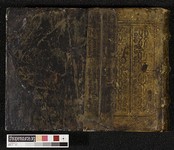
Half-leather binding from the 1620s, in which this fragment was originally an internal reinforcement. For the full description of the host volumes and their bindings, see the virtual reconstruction F-bk3f.
This strip is placed vertically down the middle of the front cover across the decorated leather and another piece of parchment, possibly from a liturgical manuscript, which covers the rest of the board. On the front pastedown, the offset of a fragment from the same leaf, F-whed (longer strip), is visible. This suggests that at some point both strips were added to the binding later to repair a tear or crack in the board. The loose fragment was removed again during a bookbinding intervention performed in the 20th century.
Bibliography
-
Holck, Jakob Povl. ‘Herlufsholm-Samlingen På Syddansk Universitetsbibliotek Og Forskningspotentialet–Om Forskellige Fund Af Fragmenter’. Studier i Nordisk, nos 2016–2018 (2022): 5–40.
https://findresearcher.sdu.dk/ws/portalfiles/portal/212896664/Holck_Trykte_version_.pdf -
Kongsted, Ole. ‘Herlufsholm-Samlingen R 121-125 Og Danskerne i Italien Omkring 1600’. In Umisteligt: Festskrift Til Erland Kolding Nielsen. Det Kongelige Bibliotek, Museum Tusculanum Press, 2007.
-
Kongsted, Ole. ...‘...Derforuden i et Bundt Endeel Gl. Musicalia, Mutilerede, u-Nyttige Og Af Ingen Importance’. Delaspekter Vedrørende Musikmanuskripterne i Herlufsholm-Samlingen i Syddansk Universitetsbibliotek. I Sofie Lene Bak (Red.)“Kildekunst”–Historiske Og Kulturhistoriske Studier. Festskrift Til John T. Lauridsen. Bd 1 (2016): 89–115.