Petrus Lombardus, Collectanea in epistolas Pauli
Gloss to the letter to the Romans
F-bk3f

I thank Lars Boje Mortensen (University of Southern Denmark) for sharing his opinion on the origin and dating of the script.
General Information
Praegothica from the second half of the 12th century, possibly a little later, if one takes a possible Danish origin into account. There are still no junctures (Bogenverbindungen), but ligatures are present (ct, st), and the letters are packed fairly tightly. Straight d still outnumbers curved d, f and tall s stand on the baseline, and serifs are generally curved and face right.
Original Condition
Probably from a folio manuscript, intercisum format with main text in a larger script and the commentary arranged around it in a smaller, heavily abbreviated script.
Current Condition
Some staining and damage from handling and glue.
Content
-
Content Item
- Persons Petrus Lombardus
- Text Language Latin
- Title Letter to the Romans (I, 8-10)
-

- Edition J. P. Migne, Collectanea in epistolas Pauli 1 (Petrus Lombardus), PL 191, 1854. Corpus Corporum ID 11,454. At pp. 1318A-B.
-
Content Item
- Persons Petrus Lombardus
- Text Language Latin
- Title Letter to the Romans (IX, 22-26)
-
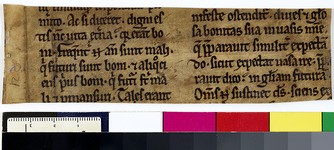
- Edition J. P. Migne, Collectanea in epistolas Pauli 1 (Petrus Lombardus), PL 191, 1854. Corpus Corporum ID 11,454. At pp. 1468A-D.
History
Germany or Denmark?
The manuscript was probably used in a Danish monastery until around the time of the Reformation (1536/37) and subsequently dismembered for reuse in a stationer's shop. The K 14 bindings are from the 1620s, at which point there was not much monastic parchment in circulation in Denmark anymore, explaining the small size and ecclectic mixture of fragments used.
Host Volume
Some of the fragments in this reconstruction have been removed from the host volumes, while others remain in situ. The Lombardus fragments are all associated with the bindings of RARA Musik K 14 121 and 125, two volumes of a series of paper manuscripts containing polyphonic music from around 1600. There were originally at least twelve volumes, of which five survive, distinguished by their RISM identifiers 121-125. K 14 belonged to Herlufsholm Skole, a private Latin school located in Næstved, Sealand founded in 1565 on the grounds of a secularised Benedictine monastery, St Peders Kloster. The old library of Herlufsholm was transferred to the University Library of Southern Denmark in 1968-69.
Ole Kongsted hypothesises that the musical pieces in the host volumes were collected by Danish musicians who travelled to Italy around 1600s. How and when the books entered Herlufsholm is unclear, but the bindings were certainly made locally for the school, as the stamp on volume 124 indicates (Possess. Herlufs H.). They sport blind-tooled half-leather bindings with covers made of several reused parchment manuscripts. The outer fragments remain in situ, but further parchment fragments were originally inside the bindings as spine supports, but they were extracted during a bookbinding intervention in the 20th century along with the wastepaper that made up the paste-laminate boards. The bindings are all stamped 1604, which cannot refer to the year they were bound, since among the extracted material from the original paste-laminate boards we find copious leaves containing writing exercises from Herlufsholm, dated 1624-26.
Among the extracted parchment fragments there are two small fragments of a parchment missal printed for the diocese of Odense (F-lcqd, 1501). This places the Lombardus manuscript, along with the other medieval fragments, in a Danish monastic or ecclesiastical collection before the Reformation.
Bibliography
-
Holck, Jakob Povl. ‘Herlufsholm-Samlingen På Syddansk Universitetsbibliotek Og Forskningspotentialet–Om Forskellige Fund Af Fragmenter’. Studier i Nordisk, nos 2016–2018 (2022): 5–40.
https://findresearcher.sdu.dk/ws/portalfiles/portal/212896664/Holck_Trykte_version_.pdf -
Kongsted, Ole. ‘Herlufsholm-Samlingen R 121-125 Og Danskerne i Italien Omkring 1600’. In Umisteligt: Festskrift Til Erland Kolding Nielsen. Det Kongelige Bibliotek, Museum Tusculanum Press, 2007.
-
Kongsted, Ole. ...‘...Derforuden i et Bundt Endeel Gl. Musicalia, Mutilerede, u-Nyttige Og Af Ingen Importance’. Delaspekter Vedrørende Musikmanuskripterne i Herlufsholm-Samlingen i Syddansk Universitetsbibliotek. I Sofie Lene Bak (Red.)“Kildekunst”–Historiske Og Kulturhistoriske Studier. Festskrift Til John T. Lauridsen. Bd 1 (2016): 89–115.