Breviary
Commemoration for St Walburga's translation; office for Philippi Jacobi (1 May)
F-a3ff

General Information
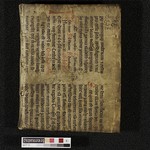
Bold, compact Northern Textualis. Short ascenders and descenders, tall s and f on the baseline. Both round and straight-backed d appear, the former more frequently. Round r only after o. No biting, but the letters are overall fairly close together.
Original Condition
Fairly wide margins.
Current Condition
The better part of a leaf survives, with some loss of text in column B due to how the parchment is folded around the host volume's boards. The portion of the fragment that covers the host volume's spine is much lighter than the other parts, probably due to exposure to light.
Book Decoration and Musical Notation
Red rubrics and lombards.
Neumes on four-line staves.
Content
-
Content Item
- Text Language Latin
- Title Commemoration for St Walburga
-
-
Content Item
- Text Language Latin
- Title Chants and readings for the apostles Philipp and James minor
-
History
Germany?
Hope points out that St Walburga was venerated especially in the German-speaking area, so a German origin is likely. In Helmstedt, where the host volume was printed, a church was dedicated to her in the 13th century.
However, since she only appears in a commemoration in this fragment, it is likely from a place where the translation of her relics and canonisation was not celebrated as a major feast. She also appears in liturgical books from all over Western and Central Europe, including in the missals printed in the early 16th century for Copenhagen and Lund (Danish at the time). Nonetheless, the type of musical notation points away from Scandinavia, where square notation on red staves is more commonly found. A Northern German origin is plausible, but somewhat speculative.
Host Volume
The host volume belonged to Herlufsholm Skole, a private Latin school located in Næstved, Sealand founded in 1565 on the grounds of a secularised Benedictine monastery, St Peders Kloster. The old library of Herlufsholm was transferred to the University Library of Southern Denmark in 1968-69. This book is part of a donation made to the school by count Otto Thott (1703-1785), who became warden of the school in 1763 until his death in 1785. Well-known for his book collecting, he gave about 6000 volumes to Herlufsholm’s library in several shipments beginning in 1777.
The binding is a simple laced-case binding with three visible double endbands, about contemporary to the host volume. It was restored by bookbinder Axel Pedersen (A.P. Kons.) in 1976 according to a stamp on the back endleaf.
Bibliography
-
Holck, Jakob Povl. Den Gamle Verdens Magi: Bogsamlingen Fra Herlufsholm På Syddansk Universitetsbibliotek. Syddansk Universitetsbibliotek, 2015.
https://portal.findresearcher.sdu.dk/da/publications/den-gamle-verdens-magi-bogsamlingen-fra-herlufsholm-p%C3%A5-syddansk-u/ -
Hope, Steffen. Samlet oversigt over rapporter, tabeller og metadata samlet i perioden 01.11.17-28.02.18. Unpublished report for the University Library of Southern Denmark.