Student exercises in Danish and Latin
F-846h

General Information
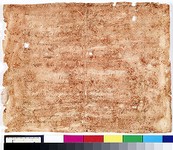
17th century humanistic cursive, several different hands in Danish and Latin.
Original Condition
Some of these fragments were originally bound together in a notebook (Jensen 1982, 166–67).
Current Condition
The pieces range from small scraps with only a few letters on them to entire leaves.
Content
-
Content Item
- Text Language Latin & Danish
- Title Student exercises
-
Host Volume
RARA Musik K 14 is a series of paper manuscripts containing polyphonic music from around 1600, from which the student exercises were extracted. There were originally at least twelve volumes, of which five survive, distinguished by their RISM identifiers 121-125. K 14 belonged to Herlufsholm Skole, a private Latin school located in Næstved, Sealand founded in 1565 on the grounds of a secularised Benedictine monastery, St Peders Kloster. The old library of Herlufsholm was transferred to the University Library of Southern Denmark in 1968-69. Ole Kongsted hypothesises that the musical pieces in the host volumes were collected by Danish musicians who travelled to Italy around 1600s. How and when the bindings entered Herlufsholm is unclear, but the bindings were certainly made locally for the school, as the stamp on volume 124 indicates (Possess. Herlufs H.). They sport blind-tooled half-leather bindings with covers made of several reused parchment manuscripts. The outer fragments remain in situ, but further parchment fragments were originally inside the bindings as spine supports, but they were extracted during a bookbinding intervention in the 20th century along with the wastepaper that made up the paste-laminate boards. The bindings are all stamped 1604, which however cannot be the year they were bound, since among the extracted student wastepaper from the original paste-laminate boards we find copious leaves that are dated 1624-26.
Bibliography
-
Holck, Jakob Povl. Den Gamle Verdens Magi: Bogsamlingen Fra Herlufsholm På Syddansk Universitetsbibliotek. Syddansk Universitetsbibliotek, 2015.
https://portal.findresearcher.sdu.dk/da/publications/den-gamle-verdens-magi-bogsamlingen-fra-herlufsholm-p%C3%A5-syddansk-u/ -
Holck, Jakob Povl. ‘Herlufsholm-Samlingen På Syddansk Universitetsbibliotek Og Forskningspotentialet–Om Forskellige Fund Af Fragmenter’. Studier i Nordisk, nos 2016–2018 (2022): 5–40.
https://findresearcher.sdu.dk/ws/portalfiles/portal/212896664/Holck_Trykte_version_.pdf -
Jensen, Kristian. Latinskolens Dannelse. Latinundervisningens Indhold Og Formål Fra Reformationen Til Enevælden. Copenhagen, Museum Tusculanums Forlag, 1982.